September 10, 2025
Rocket Learning Rewards
As sure as it won’t be the last of many such headlines, it was still disconcerting to read about Lufthansa’s decision to cut 4,000 administrative roles in a push to replace them with AI in the name of cost efficiencies. Bosch is doing much the same, at an even larger scale.
Some of the reasons for these cuts are specific to the German automobile manufacturing industry — but no one can be anything but shocked at the speed and scale at which they are taking place.
AI is coming for every worker’s and professional’s role to some degree.
A recent report highlights that many tech roles have already been redefined or reassigned as a result of AI adoption.
It may not always result in direct replacement, but as the technology improves and grows ever more capable, it will require the cycle of upskilling to happen that much more frequently.
Constantly, in fact.
Organisations now face an urgent imperative. If a role can’t be replaced with AI entirely, they still need to reskill their workforce for higher-value activities. This transition requires employees to embrace continuous learning at an unprecedented scale and pace.
Companies like Citibank are stipulating that their staff have to undergo mandatory AI prompt training to boost proficiency across the board and its likely more will follow suit.
However, traditional training approaches often fall short of generating the deep, sustained engagement necessary for meaningful reskilling. Likewise, the persistent threat of replacement is a poor extrinsic motivator for any employee. The mental stress impact is not even worth thinking about.
The only alternative is to make reskilling individually driven and sustainably motivating.
Research conducted through partnership with Learnovate demonstrates that fostering intrinsic motivation to learn through carefully designed reward systems offers a viable pathway for organisations to navigate this rapid transformation successfully.
The challenge is multifaceted. Unlike one-time compliance training, AI-era reskilling requires ongoing adaptation and learning agility. Employees must not only acquire new skills but also develop meta-learning capabilities — the ability to learn how to learn effectively in rapidly changing environments.
This level of engagement cannot be achieved through external pressure alone; it requires genuine internal motivation that sustains effort over extended periods and through occasional barriers.
Neuroscientific research provides crucial insights into how reward systems can support — rather than undermine — intrinsic motivation.
Actively earned rewards elicit stronger brain activation than passive rewards, particularly in regions associated with motivation and creativity. When employees earn rewards by demonstrating mastery of new skills or innovative application of learning, the learning itself becomes inherently rewarding.
Intrinsic motivation remains the strongest predictor of quality performance. That makes it essential to design complementary reward systems that enhance, rather than diminish, internal drive.
Achievement-based rewards that recognise competence and autonomy strengthen intrinsic motivation — particularly when framed as feedback about progress rather than external control mechanisms. Rewards satisfy psychological needs for autonomy, competence, and relatedness while providing practical pathways for career advancement in an AI-integrated workplace.
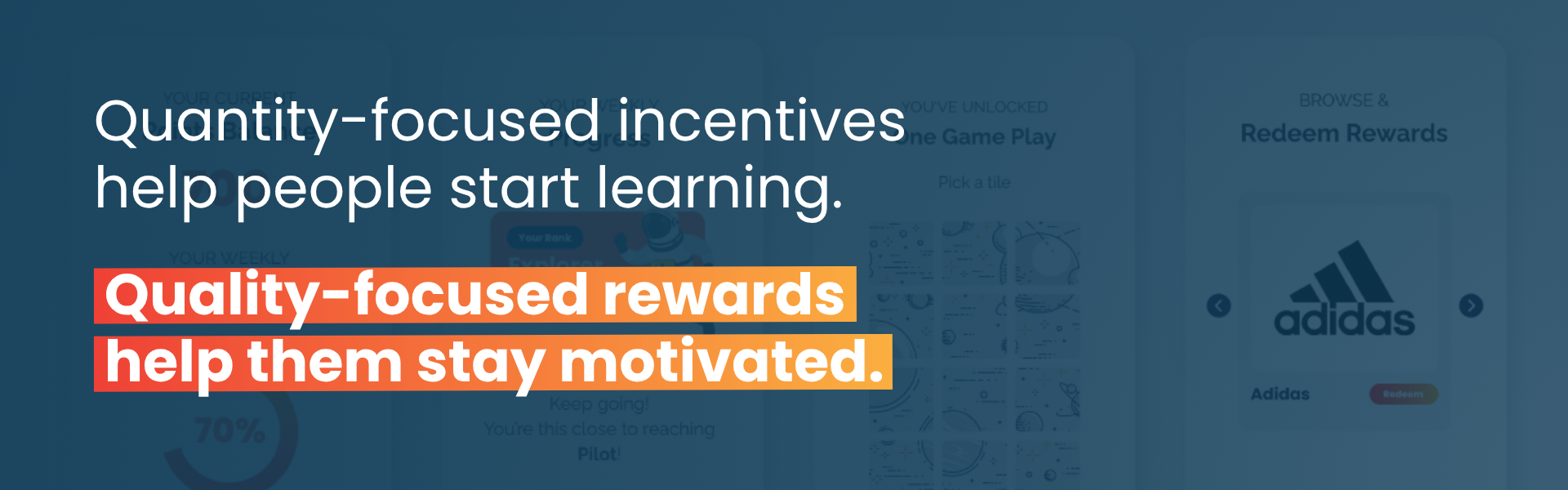
Quantity-based rewards work well for initial skill acquisition, helping employees develop sustainable behaviours that overcome the activation energy required to begin learning new competencies.
However, deep understanding and creative application — the areas where humans still outpace AI — depend on rewards that preserve and enhance intrinsic motivation.
Organisations implementing these approaches report not only higher participation rates in reskilling programmes but also improved innovation and adaptability among participants. Employees who develop strong intrinsic motivation for learning become more resilient to technological change, viewing new developments as opportunities rather than threats. Having a tangible yet meaningful set of rewards alongside supports their motivation even more.
In an AI-driven future, the organisations that thrive will be those that cultivate continuous learning cultures where personal development becomes intrinsically rewarding.
This requires moving well beyond current training models towards sophisticated, configurable reward systems that recognise the complex psychology of motivation — and leverage it to create sustainable competitive advantage.